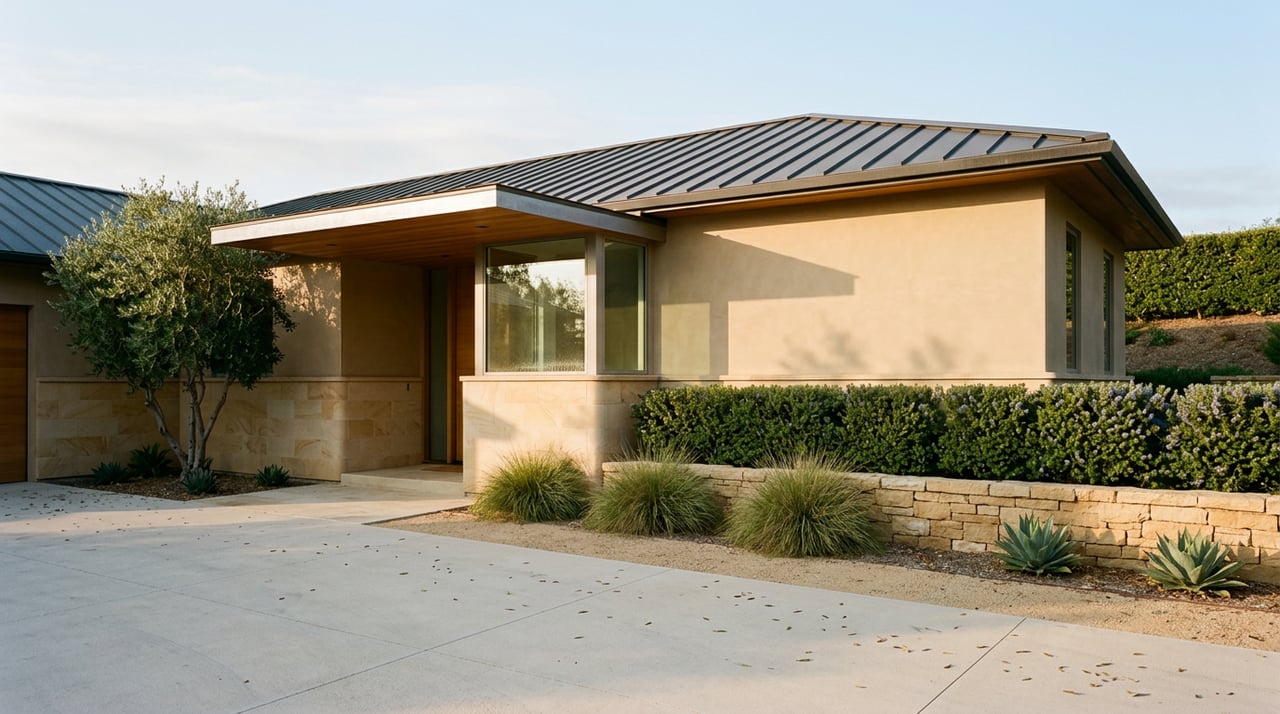
In West Hills, Two Homes on the Same Street Can Belong to Two Different Insurance Markets
September 10, 2026
September 10, 2026
What if the biggest risk in your West Hills purchase has nothing to do with the house? Ask two owners on the same block whether their homeowners insurance renewed this year without a fight, and you can get two completely different answers, not because one house is better built than the other, but because of which side of the street each one sits on.
That split is not a rumor passed between neighbors. It is how California actually classifies risk in this part of the San Fernando Valley, and it is the single fact about West Hills real estate that a portal search will never show you.
West Hills sits at the far western edge of the Valley, where the flat residential grid gives way to open space toward Bell Canyon and the foothills of the Santa Susana Mountains. That geography is the whole story. California's Fire Hazard Severity Zone system, maintained by CAL FIRE, rates land as Moderate, High, or Very High based on vegetation, slope, weather, and fire history, and the state redrew those maps in March 2025 for the first time since 2011. Los Angeles County's Very High designation expanded under that update, growing by roughly 29 percent according to a review of the new maps.
None of that expansion cares about a subdivision's marketing name. It follows the terrain. A parcel with a wall of native brush behind it can sit in a Very High zone while a nearly identical home four houses down, set back from the interface, sits in a Moderate zone or outside the mapped area entirely. Zachary Schneiderman, who founded a Granada Hills insurance agency after a career in real estate development, has described exactly this pattern for West Hills homes backing onto Bell Canyon and the Santa Susanas: eligibility can turn on which side of a street a lot falls on, not on the neighborhood name a listing agent used in the MLS.
A Moderate zone parcel usually still qualifies for a standard admitted carrier policy, the kind most buyers assume they will get. A High or Very High zone parcel often does not. When a standard carrier declines or non-renews, the options run down a ladder: an admitted carrier that still writes in that specific zone, then surplus lines coverage, and finally the California FAIR Plan, the state's insurer of last resort.
Statewide, FAIR Plan enrollment climbed from about 154,000 policies in 2019 to roughly 668,000 entering 2026. In the highest-risk zip codes specifically, close to 41 percent of homes carried FAIR Plan coverage as of March 2026. The FAIR Plan only covers fire, so most mortgage lenders will not accept it alone. Buyers typically have to pair it with a separate Difference in Conditions policy that fills in liability, theft, water damage, and loss of use. That second policy, from a second carrier, is one more moving piece that has to be in place before a lender will fund the loan.
Here is the comparison that matters more than any median price:
| Parcel away from the wildland edge | Parcel backing to Bell Canyon or the Santa Susana foothills | |
|---|---|---|
| Typical fire hazard zone | Moderate or unmapped | High or Very High |
| Standard admitted coverage | Usually available | Often declined or non-renewed |
| Likely policy structure | Single standard homeowners policy | FAIR Plan fire policy plus a DIC wrap, or surplus lines |
| Extra document required before close | None | Defensible Space Inspection compliance record |
| Where delays show up | Rarely | Loan contingency window, funding date |
If your West Hills listing sits in a mapped High or Very High zone, California law has required, since July 1, 2021, that sellers provide documentation of a compliant Defensible Space Inspection before the sale closes. That is not a suggestion buried in a disclosure packet. It is a state requirement tied directly to the zone designation, and CAL FIRE's own defensible space page explains how to request the inspection.
The City of Los Angeles adds its own layer on top of the state rule. Under a 1997 amendment to the municipal code, properties in the Very High Fire Hazard Severity Zone are required to maintain vegetation clearance out to 200 feet from any structure, beyond the 100-foot minimum that applies more broadly under state law. A seller who has let that clearance lapse is not just facing a cosmetic fix. They are facing a documentation gap that can hold up closing on a property that may already be harder to insure.
The mistake that catches buyers off guard is timing, not risk itself. A buyer who waits until the loan contingency deadline to ask about insurance can find that the answer changes their financing entirely, with no time left to adjust. The FAIR Plan plus DIC combination costs more and takes longer to assemble than a single standard policy, and a lender will not fund without proof of coverage in hand.
The sequence that avoids this looks different from a standard purchase:
There is also a protection worth knowing about if you already own in one of these zones and a nearby fire triggers a declared emergency. Under Senate Bill 824, insurers cannot non-renew a policy for one year following a declared wildfire emergency in that zip code, even if the home itself was untouched. That moratorium buys time after a specific event, but it does not stop a routine underwriting non-renewal that has nothing to do with a nearby fire. Separately, California law requires insurers to give at least 75 days written notice before any non-renewal, which is the real window sellers have to shop for replacement coverage if a letter arrives while a home is listed.
West Hills homes were selling in about 36 days on average over the three months ending May 2026, based on recent market tracking. A market moving that fast leaves little room for a surprise that adds two or three weeks to underwriting. The insurance question is not a footnote to a West Hills transaction near the hillside edge. For a meaningful share of the neighborhood's inventory, it is one of the first questions to answer, not the last.
Does a Very High Fire Hazard Severity Zone designation mean a lender will reject the loan? Not by itself. Lenders require proof of insurance before funding, not a specific zone rating. The zone affects which type of policy is available and how long it takes to assemble, which is why the timing matters more than the label.
Can a homeowner dispute or appeal a property's fire hazard zone designation? The zones are mapped by CAL FIRE based on terrain, vegetation, and fire history rather than assigned property by property, so there is no individual appeal process tied to a single parcel. Documented mitigation, such as a completed defensible space inspection or hardened roof and vents, can still improve which carriers are willing to write a policy.
What happens if a seller's insurance is non-renewed while the home is actively listed? California law requires at least 75 days notice before a non-renewal takes effect, which gives a seller time to secure replacement coverage or disclose the situation to a buyer. Either way, it is worth surfacing early rather than letting a buyer discover it mid-escrow.
Insurance eligibility in West Hills is a parcel-by-parcel question, and getting it answered before you write an offer or accept one is part of protecting the deal itself. If you are buying or selling near the hillside edge of West Hills and want a clear read on what a specific address means for financing and timing, Jonathan Burstein can walk through it with you. Schedule a consultation before your contingency clock starts running, not after.

Connect with a real estate professional who values trust, insight, and personal attention. Every step is guided by a deep understanding of what “home” truly means.